
Man vs Machine: When Mentalism Met MRI Technology
For years, documentaries and newspaper headlines have claimed that advances in brain imaging technology could one day allow scientists to read human thoughts.
In 2014, I was invited to take part in a live public experiment exploring exactly that idea.
The project, titled Man vs Machine, brought together mentalism, neuroscience and MRI technology as part of Sheffield’s Festival of the Mind - a major cultural event organised by the University of Sheffield celebrating the relationship between science, creativity and human thought.
At the centre of the experiment was a simple but fascinating question:
Could a multi-million-pound MRI scanner successfully identify what somebody was thinking… and could it compete with a professional mind reader?
An Unexpected Invitation from Sheffield University
The entire project began with an email completely out of the blue.
Dr Aneurin Kennerley, a physicist and research fellow specialising in MRI brain imaging at the University of Sheffield, contacted me with an unusual proposal.
His research focused on using Magnetic Resonance Imaging (MRI) technology to study brain function and perception. At the time, public fascination surrounding “mind reading technology” was rapidly growing, fuelled by sensational headlines and documentaries claiming that MRI scanners could potentially detect lies or even interpret thoughts.
Aneurin wanted to create a live public event exploring the reality behind those claims while making the science accessible and engaging for a wider audience.
His idea was simple:
combine a live neuroscience experiment with a theatrical “Man vs Machine” challenge between modern technology and psychological performance.
Needless to say, I was immediately interested.
The Festival of the Mind
The show formed part of Sheffield’s Festival of the Mind, an 11-day event organised by the University of Sheffield bringing together researchers, artists and creative collaborators from across the city.
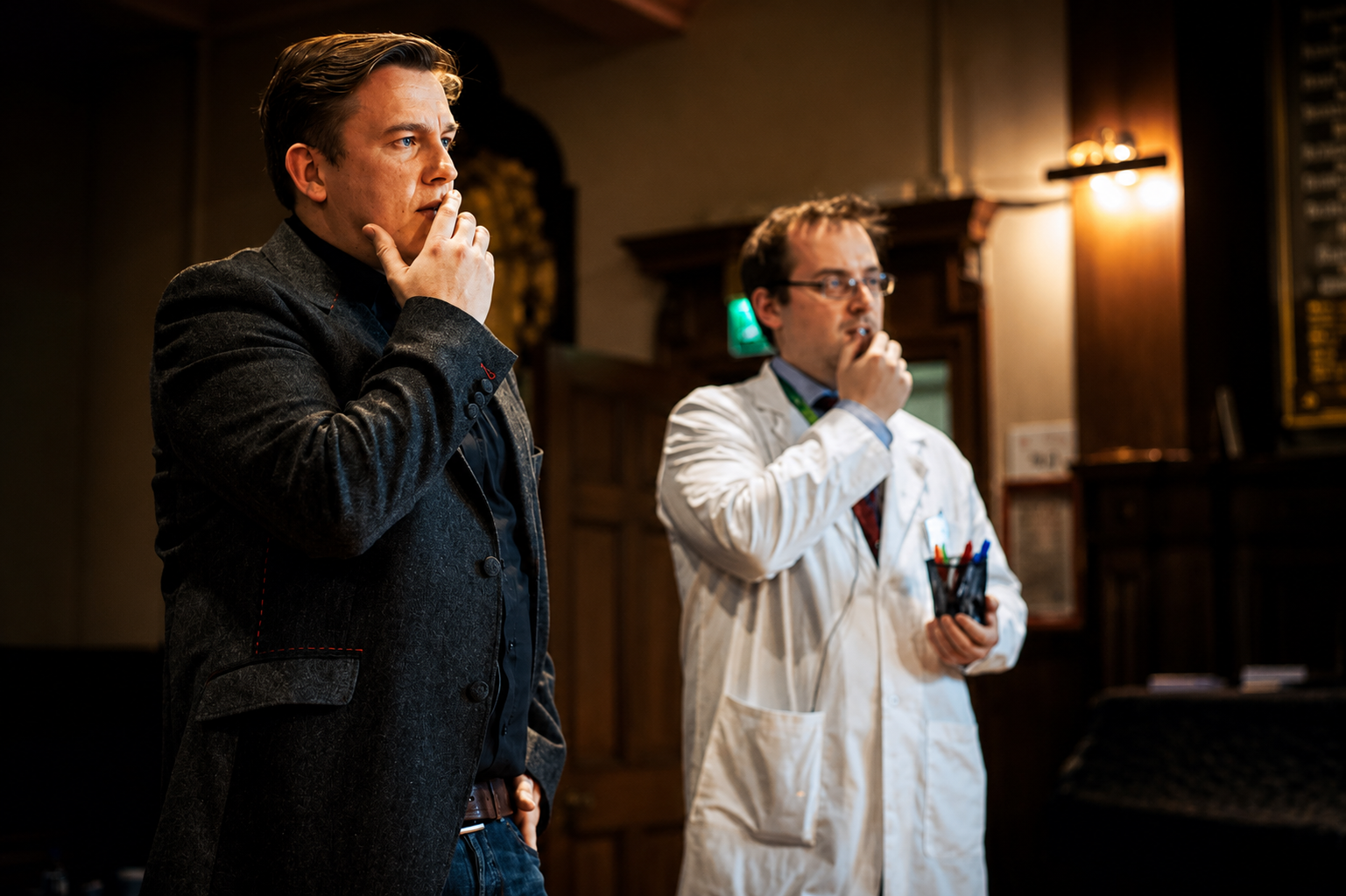
The festival itself was designed to explore the capabilities of the human mind through science, psychology, performance and culture.
For me, it was the perfect environment for a project like this.
The concept blurred the line between science demonstration, live theatre and psychological entertainment - exactly the type of creative challenge I enjoy most.
Can MRI Technology Read Minds?
The premise behind the show was both genuine and intentionally tongue-in-cheek.
Audience members would watch as a participant underwent a real MRI scanning procedure at the University Hospital. During the scan, they would be shown a series of different images including:
faces
houses
cubes
spheres
As each image appeared, the MRI scanner would record the participant’s brain activity.
The participant would then secretly choose one image to focus on again.
Using the resulting brain scan data, Aneurin and his research team would attempt to determine which image had been selected by comparing visual activity maps produced by the MRI scanner.
In other words:
the University would attempt to “read” the participant’s thoughts using advanced neuroscience technology.
At the same time, I would attempt to achieve exactly the same result live on stage using psychological performance techniques.
The result became:
Man vs Machine
Inside the MRI Scanner
Before the live performances took place, I was invited to undergo the scanning procedure myself.
I quickly discovered that MRI scanners are far less glamorous than television documentaries tend to suggest.
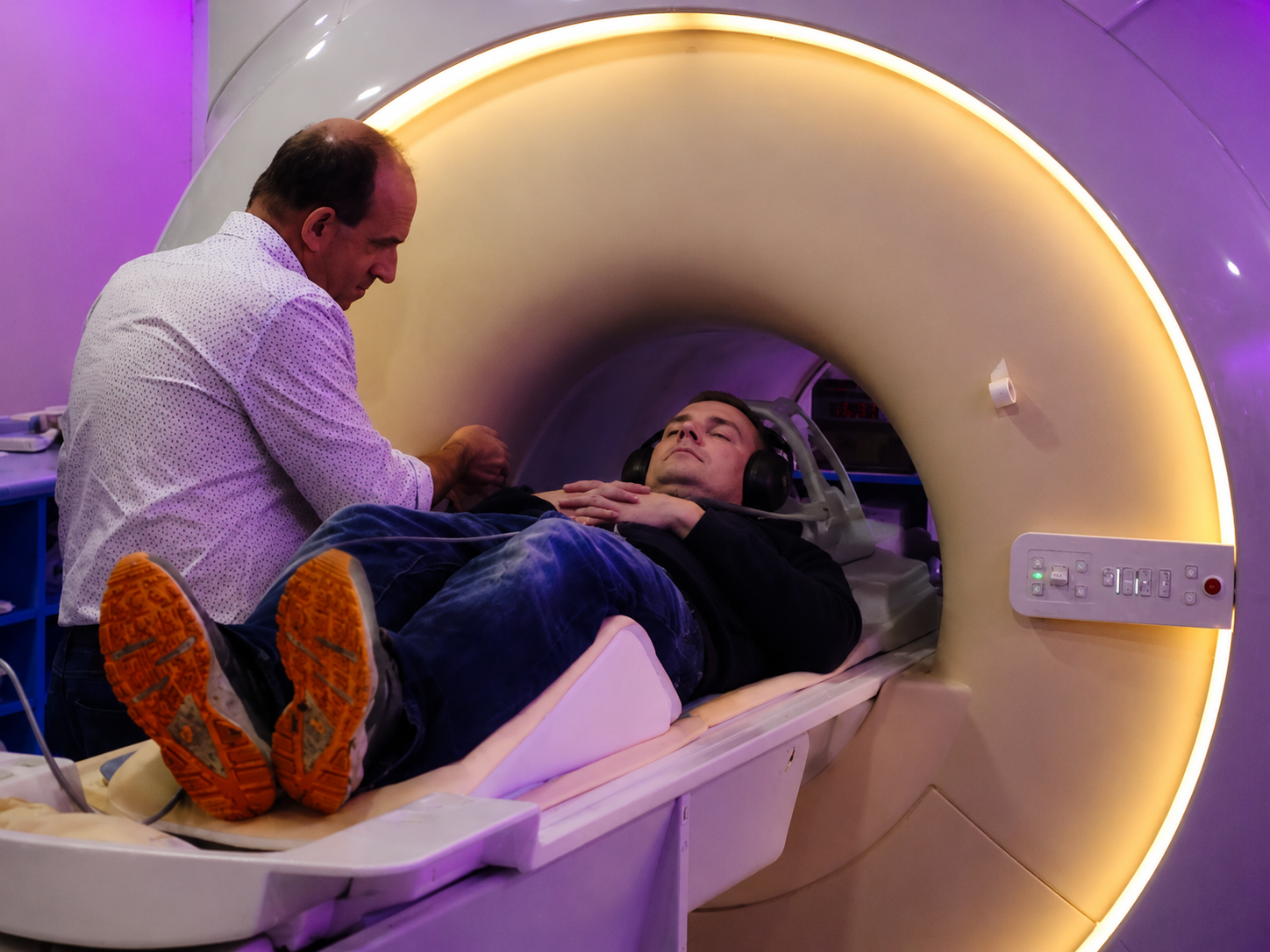
Lying motionless inside a giant cylindrical machine for an extended period of time while surrounded by intense mechanical noise is a genuinely strange experience. The repetitive electronic rhythms almost became hypnotic after a while, occasionally sounding more like experimental music than medical equipment.
The process was also surprisingly claustrophobic.
At one point, I remember joking that my greatest concern wasn’t what they might find during the scan, but whether there was enough inside my head worth scanning in the first place.
Despite the surreal environment, the experience gave me a fascinating insight into the scientific side of the project and the incredible level of work happening behind the scenes.
Bringing Science and Mentalism Together
The live performances took place over two consecutive nights inside Sheffield’s famous Spiegeltent venue as part of the festival programme.
Both shows sold out.
The atmosphere inside the venue was unlike a traditional theatre performance. The audience weren’t simply watching a show - they were watching an experiment unfold in real time.
The evening began with Aneurin and his research team introducing the audience to the science behind MRI technology and brain imaging before explaining the challenge itself.
A participant was then scanned remotely while the audience watched footage of the process on a large screen.
While the MRI team analysed the resulting data live on stage, I performed a psychological demonstration exploring suggestion, perception and audience interaction before attempting to determine the participant’s chosen image myself.
The tension throughout the finale was extraordinary.
On one side of the stage stood a multi-million-pound MRI scanner backed by a team of neuroscientists and researchers.
On the other stood a mentalist relying entirely on psychology, observation and performance.
The Finale
As the participant finally revealed their chosen image to the audience, both Aneurin and I displayed our predictions simultaneously.
Remarkably, we both arrived at the correct result.
The audience reaction was immense.
What made the experience so compelling wasn’t simply whether the MRI scanner “worked,” but the fascinating overlap between science, psychology, perception and human intuition.
It created conversations far beyond what a traditional performance or lecture alone could have achieved.
Beyond the Festival

Originally, the performances were intended as a one-off collaboration for the Festival of the Mind.
However, following the success of the initial shows, additional funding was secured allowing Man vs Machine to continue at further science and engineering festivals around the UK.
The project went on to become one of the standout live experiences connected to the festival and remains one of the most unusual and creatively rewarding collaborations I’ve ever been involved in.
Why Creative Collaborations Matter
One of the things I’ve always loved about psychological performance is its ability to exist far beyond traditional entertainment settings.
Sometimes the most memorable projects emerge when live performance intersects with completely different worlds:
science
technology
education
psychology
innovation
Man vs Machine was a perfect example of that.
It demonstrated how live experiences can entertain audiences while simultaneously provoking curiosity, discussion and genuine wonder.
Planning a Creative or Experiential Event?
Whether it’s a corporate event, public engagement project, conference or immersive live experience, bespoke psychological entertainment can create memorable moments that audiences continue discussing long after the event itself has ended.
If you’re developing an event built around creativity, psychology, innovation or audience interaction, feel free to get in touch.
